



AI isn’t a talent, it’s a skill
AI is now a regular part of how work gets done. According to Beautiful.ai’s 2026 AI in the Workplace Survey, daily AI usage among managers increased from 18% to 34% in a single year. Yet access to the same tools doesn’t produce the same results.
Some employees use AI to accelerate research, create content, and streamline workflows. Others walk away frustrated, convinced the technology doesn’t work very well. The difference is rarely the tool itself. It’s how people use it.
That gap is best explained by prompt literacy: the ability to communicate clearly with AI systems so they can produce useful, accurate, and relevant outputs. AI requires direction, context, and constraints. Without them, it fills in the blanks on its own.
Like writing, presenting, or data analysis, prompt literacy is a learnable skill. As AI becomes part of everyday work, the organizations that invest in developing that skill will get far more value from the tools they already have.
AI prompting requires particular language and direction
Prompting is not the same as typing keywords into a search engine, nor is it exactly like talking to a colleague. AI responds best when instructions are structured and specific.
For example, instead of asking AI to “write a proposal,” provide information about the audience, desired tone, length, and goals. The more context you provide, the fewer assumptions the model has to make.
Prompt literacy also involves iteration. Effective users refine instructions, evaluate outputs, and adjust their approach over time. The process is repeatable because the underlying principles remain consistent across tools.
The takeaway is simple: better inputs produce better outputs.
Teams equipped to master AI perform better
Most organizations have focused on AI adoption but not AI proficiency.
The 2026 AI in the Workplace Survey found that 77% of managers are adopting AI to improve efficiency and productivity. At the same time, usage is becoming routine, with 72% using AI at least weekly. The question is no longer whether teams use AI. It’s how effectively they use it.
Without training, employees develop their own habits. Some discover effective workflows. Others rely on trial and error. The result is inconsistent quality across teams using the same tools.
Prompt literacy closes that gap. When organizations establish best practices, create standards, and invest in training, AI becomes more predictable and valuable. Better prompting leads to better outputs, greater efficiency, and a stronger return on AI investments.
Bad input = bad output
AI can analyze information and generate content at remarkable speed, but it still depends on human direction.
Vague prompts often lead to generic results. Detailed prompts produce outputs that are more useful, accurate, and aligned with business goals.
A useful way to think about prompting is to imagine onboarding a new teammate. They may be capable, but they lack context. You would explain the objective, provide background information, and clarify expectations. AI works much the same way.
When people claim AI produces poor results, the root cause is often a lack of specificity rather than a limitation of the technology itself. The quality of the output is closely tied to the quality of the instruction.
Prompting is becoming a core workplace skill
Many workplace skills that feel essential today were once considered optional. Email, spreadsheets, and digital collaboration tools all followed that path.
Prompt literacy is heading in the same direction.
The shift is happening alongside growing concerns about AI’s impact on careers. According to Beautiful.ai’s 2026 AI in the Workplace Report, 70% of managers believe employees fear AI could eventually lead to job loss, while 72% believe workers worry AI will make them less valuable. At the same time, confidence in AI capabilities continues to rise.
That creates an opportunity for employees who learn how to work effectively with AI rather than compete against it. As AI becomes embedded in daily workflows, people who know how to direct, evaluate, and refine AI outputs will have a clear advantage.
Prompt literacy is increasingly becoming a professional skill, not a technical specialty.
The best prompts read like detailed instructions
The strongest prompts usually contain four elements:
- Clear objective: Explain what you want AI to accomplish.
- Relevant context: Provide background information, documents, or supporting details.
- Specific instructions: Tell AI exactly what to do.
- Desired output format: Define how you want the response structured.
For example:
Instead of: “Edit this email.”
Try: “Rewrite this customer newsletter using concise, conversational language while keeping a professional tone.”
Instead of: “Make me a pitch deck.”
Try: “Create a 10-slide seed-stage pitch deck for a healthcare SaaS startup targeting investors.”
Small improvements in prompt structure often lead to dramatically better results.
Enablement is a team effort
Prompt literacy should not depend on individual experimentation.
Organizations can accelerate adoption by creating shared prompt templates, documenting successful workflows, and establishing clear guidelines for common use cases. This reduces duplicated effort while improving consistency.
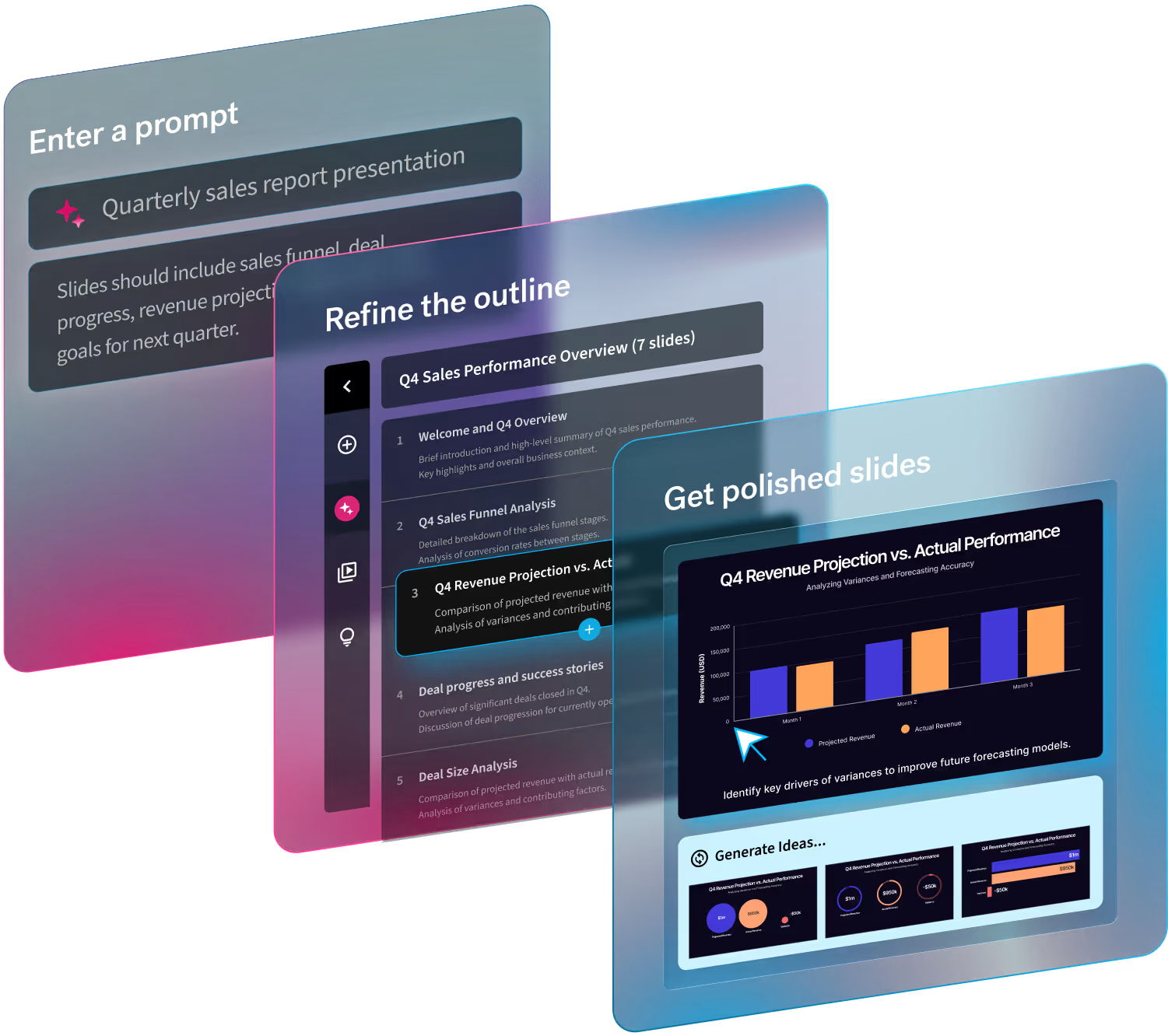
The same principle applies to presentation creation. Platforms like Beautiful.ai help organizations create more repeatable workflows by combining shared templates, brand controls, and AI-assisted presentation creation in a single environment. Instead of starting from scratch each time, teams can build from approved structures and use AI within established guidelines. The result is a clearer path to scaling AI adoption without sacrificing quality or brand standards.
When teams share what works, AI becomes easier to use across the organization. Employees spend less time reinventing prompts and more time applying insights. Companies that treat prompt literacy as a capability, not an individual talent, are better positioned to scale AI effectively as the technology evolves.
Treat prompt literacy as a trainable skill
The most effective leaders recognize that AI proficiency requires support.
Prompt literacy should be incorporated into onboarding, training programs, and professional development initiatives. Teams need opportunities to experiment, compare approaches, and learn from one another.
Just as organizations teach communication, presentation, or analytical skills, they should teach employees how to work effectively with AI.
The goal is not simply higher adoption. It’s better outcomes.
AI becomes a collaborator, not just a tool
The future of work will belong to people who know how to combine human judgment with AI capabilities.
AI can draft, analyze, summarize, and generate ideas. Humans provide context, strategy, creativity, and decision-making. Prompt literacy is the bridge between those two strengths.
Most companies are still early in this transition. That creates an opportunity for organizations and individuals willing to invest in the skill now.
The organizations that get the most value from AI won't be the ones with the most tools, they'll be the ones with the strongest processes. If you're looking to turn AI usage into measurable productivity gains, explore how Beautiful.ai helps teams create better presentations, standardize workflows, and collaborate more effectively with AI.

.avif)


.avif)
.avif)
