
.gif)
.gif)

Most startup pitch decks fail.
Not because the idea is weak. Not because the opportunity isn’t real. But because the story is unclear, the design works against the message, and the narrative fails to build investor confidence.
In today’s funding environment, investors review hundreds of decks every month. Attention spans are short. Expectations are high. If your message isn’t immediately clear and compelling, it’s dismissed.
This is why AI presentations for startups are changing the equation.
AI isn’t just helping founders write faster. When used strategically, it improves how pitch decks are structured, how stories are told, and how slides are designed. But the advantage doesn’t come from automation alone. It comes from combining strong pitch deck best practices with intelligent AI presentation tools.
Let’s start with what investors are actually looking for.
What investors really look for in a startup pitch deck
Investors are not simply scanning for information, they are evaluating risk.
Every slide should reduce uncertainty and increase confidence. Is the problem urgent and specific? Does the solution clearly address it? Is the market large enough to matter? Is there traction that proves demand? Is the business model scalable? Is this team uniquely positioned to win?
But beyond these components, investors are also assessing something less obvious: clarity of thinking.
A disorganized investor pitch deck signals disorganized strategy. A cluttered slide suggests unclear priorities. Inconsistent design subtly erodes credibility. When investors struggle to understand the story, they don’t assume complexity—they assume weakness.
This is why strong startup pitch decks are structured narratives, not just a collection of slides.
And this is where many founders go wrong.
Pitch deck best practices still matter (even in the age of AI)
Before AI enters the picture, foundational design principles need to be top of mind.
The best pitch decks communicate one core idea per slide. They don’t overload investors with competing messages. Strong decks use headlines as conclusions rather than labels. Instead of titling a slide “Market Opportunity,” they state the takeaway clearly: “A $12B Market Growing 24% Annually.” The headline guides interpretation rather than forcing the audience to draw its own conclusions.
Visual hierarchy is equally critical. The placement, size, and contrast of elements should direct attention intentionally. The most important metric on the slide should be the most visually dominant. Supporting data should reinforce—not compete with—the primary message.
Consistency also builds trust. Alignment, spacing, typography, and layout discipline communicate professionalism. When slides feel chaotic, investors subconsciously question operational rigor.
Finally, restraint is power. The strongest startup pitch decks are edited aggressively. If everything is important, nothing is.
AI does not replace these principles.
How AI improves the pitch deck creation process
The conversation around an AI pitch deck often focuses on speed. But speed is only part of the value. The real advantage is clarity at scale.
First, AI dramatically improves narrative structuring. Many founders struggle not with ideas, but with organization. AI can help outline a logical sequence, identify missing sections, and pressure-test whether the story flows from problem to solution to traction to vision. Instead of staring at a blank slide, founders can start with a structured framework and refine from there.
Second, AI strengthens messaging. It can simplify complex explanations, turn dense paragraphs into sharp headlines, and reframe jargon into language investors immediately understand. Used thoughtfully, AI becomes a collaborative partner that helps enforce precision.
Where AI becomes truly transformative, however, is in design execution.
Traditional slide software gives founders complete freedom, and with that comes big responsibility. Every spacing decision, alignment issue, and layout adjustment becomes manual work. This slows iteration and introduces inconsistency.
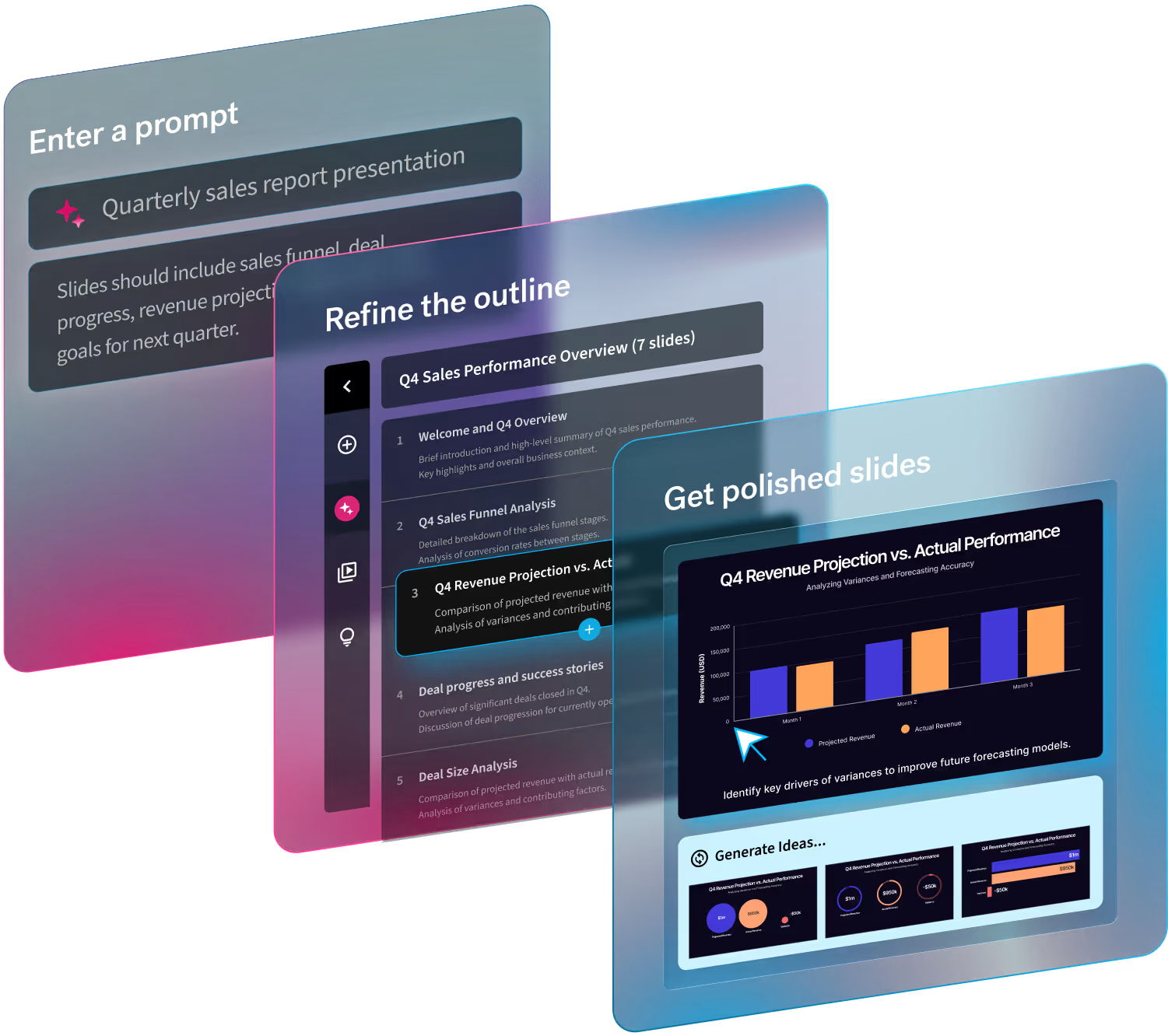
AI presentation tools like Beautiful.ai fundamentally shift this dynamic. Instead of designing from scratch, founders build within intelligent slide systems that automatically apply presentation design best practices. Layouts adapt as content changes. Visual hierarchy is preserved. Slides remain clean and structured without requiring design expertise.
This allows founders to focus on what they know, strategy and storytelling, rather than formatting.
AI also enhances data storytelling. It can recommend appropriate chart types, simplify overly complex data, and highlight growth metrics that matter most. In an investor pitch deck, numbers are not just reported, they are intentionally framed to communicate momentum and opportunity.
Perhaps most importantly, AI accelerates iteration. Founders can quickly test different headlines, reposition slides, or tailor decks for different audiences. Angels, venture capitalists, and strategic partners often respond to different emphasis. AI makes adaptation frictionless.
The mistakes founders make with AI pitch decks
AI presentations for startups can either sharpen your message or dilute it.
One common mistake is accepting generic language. If your deck sounds like it was written by a machine trained on every other startup pitch deck, investors will sense it immediately. AI should be treated as a collaborator, not a replacement for strategic thinking.
Another mistake is overloading slides simply because AI generated the content. Discipline and professional judgement still matter. Just because content exists doesn’t mean it belongs on the slide.
There’s also a risk in separating AI writing from design execution. Founders may use AI for copy, then paste it into slides that lack visual structure. The result is polished language sitting inside poorly designed layouts. The power of AI presentations comes from integrating both narrative refinement and intelligent design systems.
Finally, founders must protect their voice. Investors invest in conviction. AI should clarify your thinking, not erase your perspective.
A realistic AI workflow
The strongest startup pitch decks are built through collaboration, not automation.
It begins with the founder outlining the raw narrative: the problem, the solution, the opportunity, the traction, and the long-term vision. AI then becomes a refinement partner, stress-testing clarity, strengthening headlines, and identifying structural gaps.
Next, the deck is built inside an AI presentation platform like Beautiful.ai, where design best practices are applied automatically. The structure remains clean, slides stay visually disciplined, and layout integrity is preserved even as content evolves.
Then comes human feedback. Advisors and trusted peers review the deck not just for content, but for clarity. Where did attention drop? Which slides felt confusing? Which claims felt weak?
AI then supports rapid iteration based on that feedback.
This loop—founder insight, AI refinement, intelligent design, human critique—produces investor-ready decks faster and at a higher quality standard than traditional methods.
Why AI presentations for startups are a competitive advantage
The bar for startup storytelling has risen.
Investors now expect clarity, polish, and narrative cohesion. A sloppy deck signals lack of preparation. A confusing one signals lack of strategy. AI presentations for startups are not about replacing founders or automating creativity. They are about eliminating friction in the creation process so founders can think more strategically.
When paired with strong pitch deck best practices and a design-intelligent platform like Beautiful.ai, AI becomes a powerful tool. Founders iterate faster. Messaging sharpens. Slides remain consistently professional. Visual storytelling improves without requiring a dedicated designer.
In a competitive fundraising landscape, those advantages compound.
The startups that win will not be the ones who simply use AI. They will be the ones who use AI intentionally—not to replace visual storytelling, but to strengthen it.



.avif)
.avif)
.gif)
