.avif)
.avif)

In 2025 AI was still exploratory. A shiny tool that felt like a competitive edge. Perhaps the biggest shift from 2025 to 2026 isn’t that AI improved, it’s that it became normal.
Beautiful.ai’s 3rd annual AI in the Workplace Survey reveals that AI is now part of baseline operations. And as a result, the fears surrounding the technology are shifting, and managers are pivoting from testing tools to designing AI-enabled workflows.
So, what does it all mean for you and your team? Here’s what the data is really telling us—and how you can harness it to build a more productive team that wins.
Efficiency is the primary driver, setting a new expectation
The survey shows that 77% of managers are adopting AI to increase efficiency and productivity, but efficiency is no longer a differentiator for businesses trying to get ahead. Output expectations are rising across roles, regardless of company size or industry, forcing managers to rethink their workflows to keep up. Managers, and their teams, are now responsible for delivering more with the same or fewer resources. AI is setting a new expectation for efficiency benchmarks, pushing managers to redefine performance. In fact, 54% of managers believe workplace expectations have increased due to AI.
Teams need standardized workflows that incorporate AI in daily tasks, rather than prioritizing ad hoc usage.
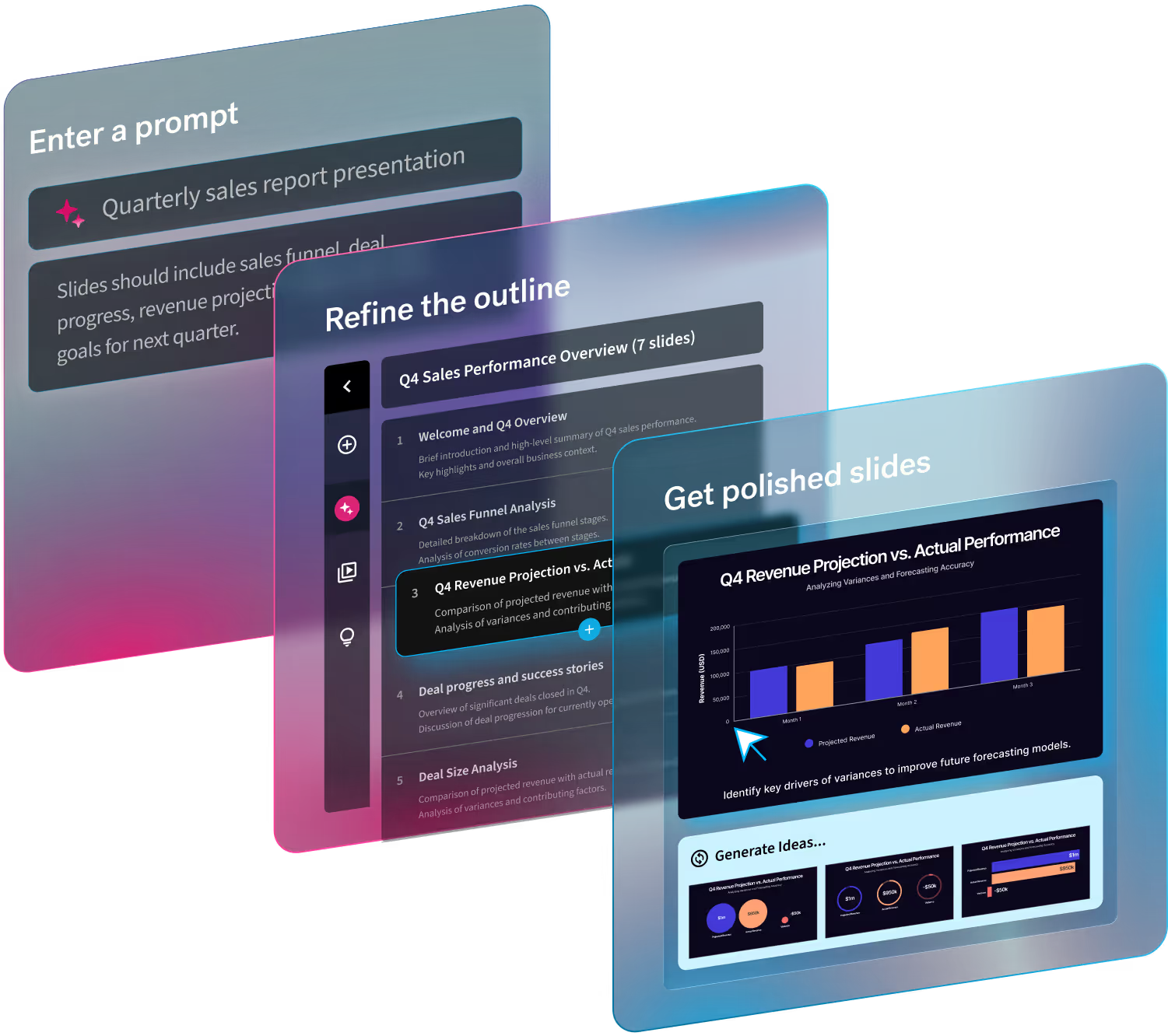
The presentation design process is a clear example of this. What was once a time-intensive, mundane process has been expedited by AI. Beautiful.ai’s Create with AI Workflow unlocks faster drafting, formatting, and iteration which in turn gives managers and their teams time back for more meaningful, strategic work. Tools like Beautiful.ai shift presentations from a tedious task to a scalable output.
AI adoption is now behavioral, not experimental
The most notable change from 2025 to 2026 is AI usage in the workplace. Daily usage increased by 16% year over year—jumping from 18% to 34%—while the managers that claim they never use AI dropped to just 7% of those surveyed. This proves an underlying theme that AI usage is now habitual and part of most teams’ daily and weekly workflows. The question is no longer if teams are using AI to enhance productivity, but how well they are using it.
Fifty-three percent of managers say they use only AI tools officially approved by their employer, while 42% indicate they are open to using tools regardless of formal regulations. The informal usage shows adoption is outpacing governance, and managers need to establish organizational best practices for more seamless team-wide adoption. If you give your employees the right tools —AI subscriptions, guidelines, and training—they’re more likely to succeed.
Tools like Beautiful.ai’s AI presentation maker gives managers the opportunity to standardize how teams create and share presentations. The new Create with AI Workflow replaces fragmented tools and acts as a centralized AI-powered workflow. Teams that adopt intentional AI tools can guarantee more consistency in outputs across teams regardless of their use cases.
AI as a peer, not a replacement tool
People used to think of AI as a quick replacement for their work. A tool that was a means to an end. With the evolving technology, confidence in AI’s capabilities is up 22% since 2025. More than half of those surveyed say AI output matches or exceeds experienced managers, and 12% believe AI outperforms human managers entirely. This is shifting the definition of high-value work.
What was once assistive, or a quick hack, is now a collaborative thought-partner. As tools continue to expand, managers must rethink how work is divided between humans and AI. Human effort shifts toward strategy, decision-making, and communication, while execution work (analysis, drafting, formatting) is increasingly offloaded to AI. Now managers can focus on strategic decisions and insights that drive the business forward, rather than storytelling structure and design.
While not a replacement for human knowledge-workers, businesses can leverage AI to expand on their ideas and turn them into impactful deliverables faster. This not only empowers existing employees to excel in their roles, but it reduces the need to increase headcount for smaller initiatives.
The tension between efficiency gains and workforce anxiety
As AI capabilities continue to evolve, and adoption soars, there’s an undeniable disconnect between intent and perception. Despite the fact that only 9% of managers say they are adopting AI with the intention of downsizing their team, workforce anxiety is increasing. The majority of managers agree that employees fear being less valuable at work, and ultimately believe they are at risk for losing their jobs altogether.
This growing fear of replacement reinforces the fact that productivity gains are arriving faster than people strategies. AI adoption without clear communication creates cultural risk, and managers need to actively manage perception, not just performance. They can do so by clarifying how AI impacts roles, what skills will be valued, and how productivity gains translate into growth (not just cost savings).
Tools like Beautiful.ai that augment employee output help reframe AI positively as a capability multiplier, not a replacement. This encourages employees to produce higher-quality work, faster, without the risk of threatening their value on the team.
What managers should do now
The shift in AI confidence and usage is undeniable, but what exactly does that mean for your team? Based on our 2026 survey data trends, here are 5 actionable tips for managers looking to formalize their AI in the workplace processes.
1. Operationalize AI, don’t just encourage it
- Build AI into repeatable workflows
- Standardize tools across teams
2. Redefine productivity metrics
- Measure output, speed, and quality—not just effort
- Align expectations with AI-enabled capabilities
3. Invest in AI-augmented workflows
- Identify high-frequency tasks (like presentations) to optimize first
- Implement tools that scale output across teams
4. Communicate early and often
- Address job security concerns directly
- Position AI as a growth tool, not a cost-cutting mechanism
5. Elevate human work
- Shift focus to strategy, storytelling, and decision-making
- Use AI to handle execution-heavy tasks
We may be biased, but a practical starting point for teams is to standardize presentation creation. By reducing time spent on formatting and design, managers can encourage faster communication of ideas across the organization.
Our new Create with AI Workflow unlocks a better way to collaborate with AI that feels more natural to how teams actually create presentations. This isn’t AI that just generates a presentation based loosely on a prompt. It’s AI that helps you create one, all while staying true to your context, your intent, your asks. This leaves the human expert in the driver seat with full control over the final output, while offering support in visual ideation and design exploration.
The businesses that scale in 2026 won’t be the ones using AI the most, they’ll be the ones that integrate it the best. Intentional tools that embed AI directly into everyday workflows—like presentations—will define how quickly organizations adapt.



.avif)

.avif)